
Putting the ‘T’ in your SLT - Building a team of leaders into a leadership team
High performing senior leadership teams are a key driver of organisational success, but what makes a team “high performing” and how do senior leaders build and grow these elements?
Individual leadership development is well-supported and budgeted for in many organisations, through leadership coaching and courses or qualifications for senior leaders, often in the technical or functional context of their individual roles. An approach of developing individual leaders can miss the crucial step of developing the team. This matters because organisations with a high performing leadership team can improve their organisational efficiency by up to thirty percent.[1] In the most senior executive leadership teams, the chance of an above median financial performance can be almost double for teams that are well aligned and working effectively together.[2]
A leadership team model relying on a single leader is outdated and inefficient - great organisations invest in a team who can all lead together
Traditionally, the concept of a leadership team in many organisations has been structured with the chief executive or most senior leader as the hub, and the leadership members as spokes of a wheel. This is reinforced by organisational structures featuring a leader with direct reports, responsible for siloed functions. These teams, which include the chief executive, are often known as the senior leadership team, or executive leadership team. The increasing speed of business transactions, increased costs, and the need for greater collaboration with other organisations means that a spoke and hub approach is not as effective or efficient at delivering impact, relying too strongly on a single individual to make decisions. MSH has an approach that builds the capability of the leadership team as a team, shifting away from the traditional concept of developing individual leaders.
The MSH TEAM framework focuses on building the elements that make leadership teams more effective
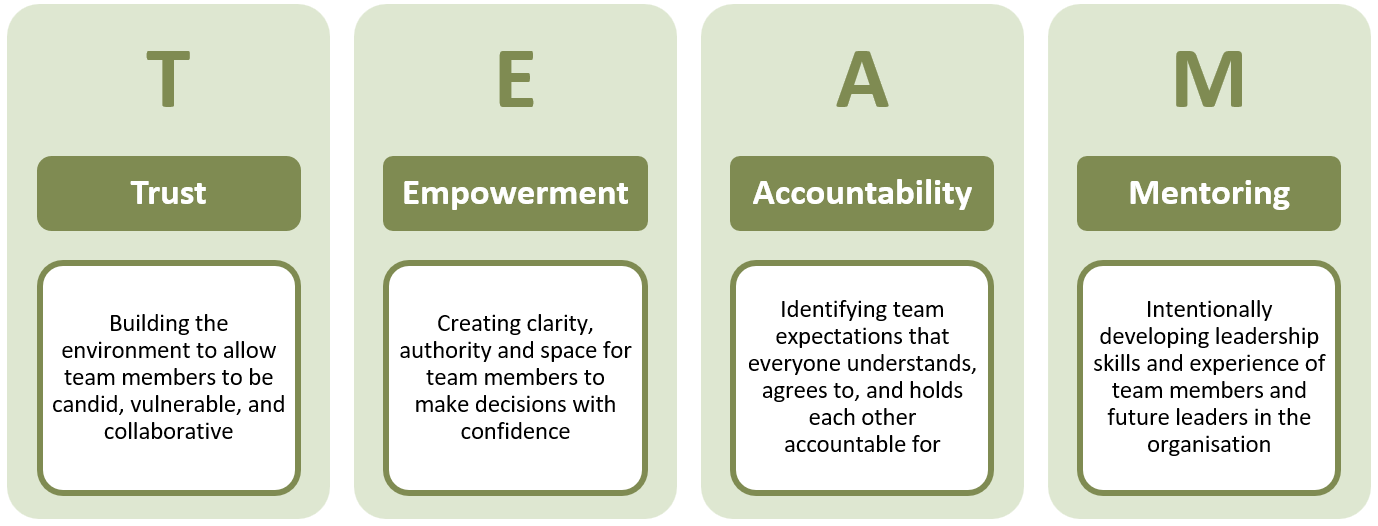
Based on our many years of experience developing and supporting leadership teams, we have identified the four critical elements that can unlock your team’s potential to become a high performing team.
TRUST
According to leadership expert Simon Sinek,[3] a team is more than a group of people who work together. A true team is a group of people who trust each other. By building trusting relationships in a leadership team, issues are surfaced earlier, conflict and debate is healthy and constructive[4], team members are committed to each other and the organisation, and consequently leadership decisions improve.
Trust is sometimes considered as a ‘soft’ leadership behaviour or strength. In fact, without it, team members will not hold the confidence required to engage with each other in a constructive and challenging way for the benefit of the organisation overall.
EMPOWERMENT
Leadership team members must be given authority, ownership and decision-making responsibility for their roles within the organisation. This is different from delegating tasks, as it is a deliberate process to provide team members with true responsibility. The effectiveness of a leadership team improves when team members are expected to use good judgement to make decisions within their authority for the benefit of the organisation.
In the book Bossy Pants,[5] author Tina Fey talks about her role as an executive producer, and says “In most cases, being a good boss means hiring talented people and then getting out of their way.” This doesn’t mean the CE or most senior leader is not involved or engaged in the work of leadership team members. Rather, it demonstrates that once capability is understood and expectations have been established, the role of the most senior leader is to focus on what is outside of the control of the team, and what needs to go right for the team to succeed. The most senior leader also supports and coaches team members while they focus on delivering the task without interference, micro-management or overreach.
Research shows that team members who have been empowered to make decisions do not require excessive management or control because they take responsibility for organisational outcomes.
ACCOUNTABILTY
Driving accountability in teams creates the right discipline to perform. While trust builds confidence, without accountability there is a risk of inconsistent performance. To address this, one of the most effective ways of driving peer-to-peer accountability is to develop and uphold team norms.[6]
Team norms are explicit agreements on how teams will work together, how decisions will be made, how they will deal with conflict and what behaviours are expected of team members. For this to work, it relies on trust (confidence to engage), so that team members can feel safe and be willing to call out behaviours that do not align with or undermine these norms.
Team norms are specific to individual teams and must be designed and agreed together for them to be authentic and to work effectively. The most senior leader must be prepared to address behaviours that are inconsistent with these norms if peer-to-peer accountability processes have not worked.
When there is peer-to-peer accountability for behaviours and decisions, teams engage together constructively, focusing on the best outcome for the organisation (regardless of their function or technical leadership role).
Success is acknowledged and celebrated by the leadership team as how the whole organisation is tracking against its goals, rather than how each department or function is performing.
MENTORING
High performing leadership teams invest in developing one another and building future leadership capability. Mentoring through peer-to-peer, leader to team member, and external support through coaching and leadership development is all viewed and planned for as a collective responsibility to strengthen organisational capability.
Opportunities for more junior members of teams to be deputised into leadership team meetings and work when their manager is absent should be encouraged, as well as allowing opportunities for people to sit in on leadership team meetings on a rotational basis. This can be as observers or participating in leadership conversations where appropriate.
Leadership teams should view mentoring not as an individual activity but as a collective responsibility to strengthen organisational capability.
Implementing the TEAM framework transforms your team from a collection of capable executives into a high performing cohesive leadership team.
Leadership teams can fall into the trap of being leadership teams in name only. Without clarity and understanding of the team’s shared organisational purpose (unifying direction), and their collective role to deliver on this, they will tend to focus on their functional leadership roles and direct reports only.
A traditional focus on individual leadership development of team members does not result in the high performing team dynamic required to effectively deliver on strategy in the current business environment. To implement a strategy that provides freedom to lead requires deliberate investment in building a high performing leadership team.
High-performing leadership teams are built through a TEAM framework. This includes a focus on: Trust that enables candour; Empowerment that builds authority; Accountability that drives peer-to-peer responsibility; and Mentoring that develops future capability. This framework can be introduced to your organisation to boost your leadership team into a high performing unit, focused on improving whole of organisation strategic success. To grow your leadership team from capable individual leaders to an effective and high performing leadership team, contact the team at MSH and we will support you through our TEAM program.
[1] McKinsey & Company. (2024, December 9). All about teams: A new approach to organizational transformation
[2] Scott Keller and Mary Meaney (2017), Leading Organizations: Ten Timeless Truths, New York, NY: Bloomsbury
[3] Sinek, S. (2014). Leaders Eat Last: Why Some Teams Pull Together and Others Don’t.New York: Portfolio/Penguin
[4] Edmondson, A. C. (1999). Psychological Safety and Learning Behavior in Work Teams. Administrative Science Quarterly, 44(2), 350–383.
[5] Fey, T, Bossypants (2011). New York: Reagan Arthur Books.
[6]Wageman, R., Nunes, D. A., Burruss, J. A., & Hackman, J. R. (2008). Senior leadership teams: What it takes to make them great. Harvard Business Press